What Size CPA Firm Should Offshore First?
One of the most common questions CPA firm leaders ask is not whether offshore accounting works, but when it makes sense for their firm.
More specifically, they ask:
“What size CPA firm should offshore first?”
Some believe offshore is only for large firms. Others think small firms need it most. Both views miss the real determinant. Offshore readiness is not defined by headcount alone. It is defined by capacity pressure, leverage maturity, and operating discipline.
This article breaks down which size CPA firms benefit most from offshoring first, which firms should wait, and how to assess readiness based on structure rather than revenue or staff count.
Why Firm Size Alone Is the Wrong Question
Firm size is a proxy, not a decision rule.
Two firms with 25 employees can be in completely different positions:
-
One is scalable and organized
-
The other is fragile and reactive
Offshore accounting amplifies whatever already exists. It does not fix weak fundamentals. That is why some small firms succeed offshore while some larger firms fail.
The right question is not “How big are we?”
It is “Where is our constraint?”
The Three Constraints That Matter More Than Size
Before looking at firm size bands, evaluate these constraints:
-
Execution overload – Are seniors, managers, or partners doing routine work?
-
Review bottlenecks – Is work piling up waiting for review?
-
Partner capacity – Are partners consistently absorbing overflow?
Offshore accounting is most effective when execution is the constraint, not when review or leadership is the constraint.
Small CPA Firms (Under 10 Staff): Usually Too Early
Why Very Small Firms Struggle with Offshore
CPA firms under 10 people often consider offshore because:
-
Hiring locally is difficult
-
Founders are overworked
-
Margins feel tight
However, offshore usually does not work well at this stage.
Common issues include:
-
No manager layer
-
Minimal process documentation
-
Partners doing everything from prep to review
-
Highly bespoke client work
In this environment, offshore adds supervision burden instead of reducing it.
When a Small Firm Might Offshore
Offshore can make sense for small firms only if:
-
Services are highly standardized
-
The firm is CAS or bookkeeping heavy
-
The owner is disciplined about process
-
Work volume is consistent
Even then, offshore should start very small and narrow in scope.
Verdict:
Most firms under 10 staff should stabilize operations first.
Lower Mid-Sized Firms (10–20 Staff): Selective Offshore
This is where offshore begins to appear viable, but only under certain conditions.
Why Firms in This Range Consider Offshore
Firms with 10–20 staff often face:
-
Founder or partner burnout
-
Difficulty hiring experienced seniors
-
Busy seasons stretching longer each year
They are large enough to feel real capacity pressure, but often still lack structure.
What Works at This Size
Offshore can work if:
-
There is at least one true manager
-
Core workflows are repeatable
-
Offshore scope is limited to execution tasks
-
Partners commit to documentation and oversight
Typical offshore use cases:
-
Bookkeeping
-
Trial balance prep
-
Tax return assembly
-
CAS execution
What Fails at This Size
Offshore fails when:
-
Used to avoid hiring a needed manager
-
Expected to reduce partner involvement immediately
-
Applied across all services at once
Verdict:
Some 10–20 person firms should offshore, but only after strengthening management and processes.
The Sweet Spot: Mid-Sized CPA Firms (20–40 Staff)
This is the size range where offshore accounting most consistently succeeds.
Why 20–40 Staff Firms Benefit First
Firms in this range typically have:
-
A defined manager layer
-
Enough volume to justify specialization
-
Clear execution vs review separation
-
Strong demand but constrained capacity
At this size, offshore directly addresses the real bottleneck: execution volume.
Typical Problems Offshore Solves Here
-
Seniors doing too much prep work
-
Managers stretched thin
-
Partners acting as backup staff
-
Growth stalled due to hiring delays
Offshore allows work to move down the stack while preserving quality control.
Outcomes Observed in This Size Band
Well-structured offshore implementations at this size deliver:
-
5–8 FTE equivalent capacity without local hiring
-
10–18 partner hours freed per week
-
15–25% margin improvement over time
-
More predictable busy seasons
Verdict:
20–40 staff firms should offshore first if they want leverage and scalability.
Upper Mid-Sized Firms (40–75 Staff): Offshore Becomes Mandatory
At this size, offshore is no longer optional. It becomes a strategic necessity.
Why Larger Firms Cannot Rely on Local Hiring Alone
Firms with 40–75 staff face:
-
Severe senior-level hiring constraints
-
Escalating salary pressure
-
Complex service mixes
-
High partner dependence
Relying solely on local hiring creates:
-
Margin compression
-
Growth ceilings
-
Burnout at leadership levels
Offshore provides elasticity that local markets cannot.
What Changes at This Size
-
Offshore teams become permanent capacity
-
Dedicated offshore leadership emerges
-
Utilization and KPIs are tracked closely
-
Offshore integrates into firm culture
Firms at this size that avoid offshore often stagnate.
Verdict:
For 40–75 staff firms, offshore is a core operating model decision.
Large Firms (75+ Staff): Offshore Is Assumed
At larger firms, the question is no longer whether to offshore, but how well it is implemented.
These firms focus on:
-
Governance
-
Quality assurance
-
Risk management
-
Multi-location delivery models
Poorly structured offshore hurts large firms more than small ones due to scale.
The Offshore Readiness Matrix
Instead of focusing on headcount alone, use this matrix:
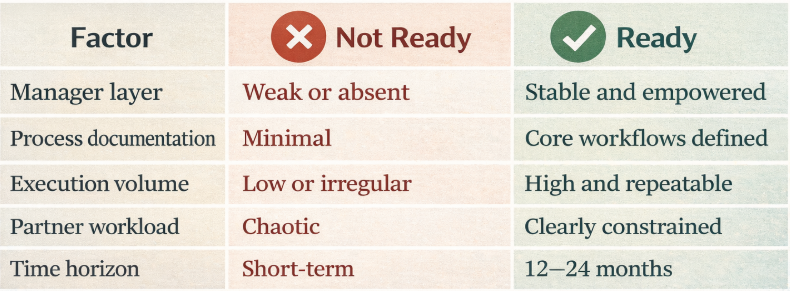
If most answers fall in the “Ready” column, offshore likely makes sense regardless of size.
Why Firms That Wait Too Long Lose More
Some firms delay offshore because:
-
“We’re not big enough yet”
-
“We’ll fix processes later”
-
“Let’s hire one more senior first”
The cost of waiting includes:
-
Partner burnout
-
Lost growth opportunities
-
Margin compression
-
Higher turnover
The firms that offshore early in the right size band capture years of compounded leverage.
The Biggest Myth: Offshore Is for Big Firms Only
In reality:
-
Very small firms struggle
-
Mid-sized firms benefit most
-
Large firms depend on it
The myth persists because firms confuse readiness with revenue.
How to Decide If Your Firm Should Offshore Now
Ask these five questions:
-
Are partners doing work below their pay grade?
-
Is execution limiting growth?
-
Do managers have review capacity?
-
Can we document core workflows?
-
Can leadership commit to 12+ months?
If the answer is “yes” to most, offshore is a fit.
What This Means for CPA Firms in 2026
In 2026, the firms that scale are not the biggest. They are the most leveraged.
Offshore accounting is no longer experimental. It is a mainstream capacity strategy for firms that have outgrown local hiring but still want control, quality, and margin stability.
Conclusion
So, what size CPA firm should offshore first? Not the smallest.Not necessarily the largest.
But the firm that has enough volume to benefit and enough structure to support it.
For most CPA firms, that moment arrives between 20 and 40 staff. Firms that recognize it early build leverage. Firms that wait too long stay constrained.
Offshore accounting does not reward size. It rewards readiness.
If your firm is ready, offshore can become one of the most powerful growth levers you deploy.