Offshore vs Hiring Seniors: A Decision Framework for 2026
In 2026, CPA firms face a staffing decision that directly determines profitability, partner workload, and growth trajectory:
Do we hire more senior accountants locally, or do we add offshore accounting capacity?
This is no longer a theoretical debate. Rising senior-level salaries, shrinking talent pools, and sustained client demand have forced firms to choose between two very different paths. Each option can work. Each option can also fail.
The mistake most firms make is framing this as a cost comparison. The real decision is about capacity, leverage, risk, and scalability.
This article provides a clear decision framework to evaluate offshore accounting versus hiring senior accountants, so firms can choose the model that fits their structure, growth goals, and operating maturity in 2026.
Why This Decision Matters More Than Ever
Senior accountants are the most constrained resource in CPA firms.
They:
-
Carry institutional knowledge
-
Review junior work
-
Interface with managers and partners
-
Protect quality and deadlines
But they are also:
-
Expensive
-
Hard to recruit
-
Prone to burnout
At the same time, offshore accounting has matured. The question is no longer “Is offshore viable?” but “When does offshore outperform hiring seniors?”
Option 1: Hiring Senior Accountants Locally
What Firms Expect When Hiring Seniors
Most firms hire seniors to:
-
Reduce partner review load
-
Stabilize busy seasons
-
Improve quality
-
Support growth
On paper, this makes sense.
The True Cost of Hiring Seniors in 2026
Fully loaded costs for a senior accountant now commonly include:
-
Base salary: $85K to $105K
-
Benefits and payroll taxes: $15K to $20K
-
Overhead allocation: $10K to $15K
Total annual cost: $110K to $140K per senior
This does not include:
-
Recruiting fees
-
Vacancy costs
-
Ramp-up inefficiency
Where Hiring Seniors Works Well
Hiring seniors makes sense when:
-
The firm lacks review capacity
-
Managers are already overloaded
-
Client complexity is high
-
Work is highly judgment-driven
-
Processes are inconsistent or bespoke
In these cases, experienced seniors stabilize delivery and reduce risk.
Where Hiring Seniors Breaks Down
Hiring seniors struggles when:
-
The firm is execution-heavy, not review-heavy
-
Seniors spend time on routine work
-
Utilization drops below expectations
-
Recruiting timelines exceed 6–9 months
-
Salary inflation compresses margins
Many firms hire seniors only to find partners still working the same hours.
Option 2: Offshore Accounting
What Offshore Accounting Actually Provides
Offshore accounting does not replace seniors. It replaces execution volume.
Offshore teams typically handle:
-
Bookkeeping and reconciliations
-
Trial balance preparation
-
Workpaper assembly
-
Tax return preparation support
-
Recurring CAS tasks
This frees seniors and managers to do what only they can do: review, judgment, and client oversight.
The Real Cost of Offshore Accounting
Typical offshore cost ranges in 2026:
-
$20 to $35 per hour fully loaded
-
$40K to $65K annual equivalent per FTE
But cost alone is misleading.
The real economic question is:
How much senior and partner time does offshore free?
Where Offshore Works Well
Offshore accounting makes sense when:
-
The firm has high volumes of repeatable work
-
Seniors and managers are doing too much execution
-
Partner hours are inflated
-
Demand exceeds capacity
-
Leadership can commit to a 12–24 month horizon
In these cases, offshore delivers capacity that hiring seniors cannot.
Where Offshore Breaks Down
Offshore struggles when:
-
Processes are undocumented
-
Managers lack time to supervise
-
Leadership expects instant savings
-
Quality standards are unclear
-
Offshore is used to fix understaffing
Offshore amplifies structure. If structure is weak, results are poor.
The Core Difference: What Each Option Actually Solves
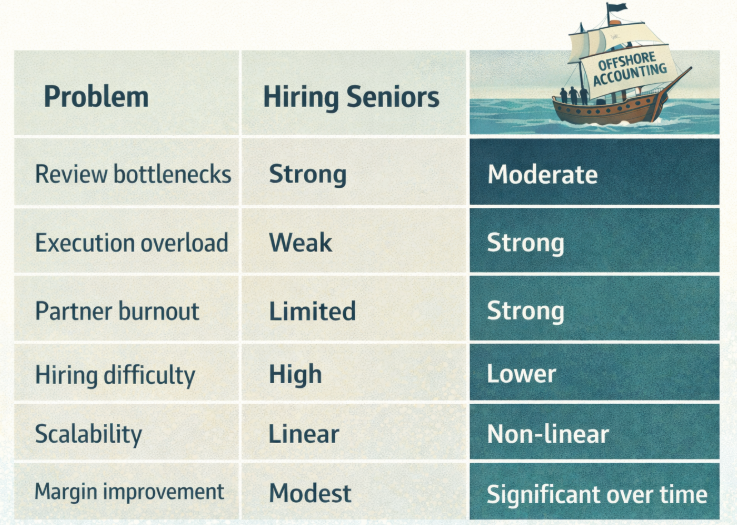
This is why many firms hire seniors and offshore successfully. The question is sequence.
A Decision Framework for 2026
Use the following framework to decide.
Step 1: Identify the Real Bottleneck
Ask:
-
Are seniors reviewing too much, or executing too much?
-
Are partners stepping into staff-level work?
-
Where do deadlines actually break down?
If review is the bottleneck: hiring seniors likely helps.
If execution is the bottleneck: offshore likely helps more.
Step 2: Assess Manager Capacity
Offshore requires managers who can:
-
Review consistently
-
Provide feedback
-
Enforce standards
If managers are already overwhelmed, hire or stabilize managers before offshore.
Step 3: Evaluate Process Maturity
Ask:
-
Are workflows documented?
-
Do similar engagements follow similar steps?
-
Is quality defined clearly?
If the answer is “mostly yes,” offshore is viable.
If the answer is “no,” hiring seniors may be safer short-term.
Step 4: Consider Time Horizon
Hiring seniors:
-
Delivers faster stabilization
-
Produces incremental gains
Offshore accounting:
-
Requires 6–12 months of investment
-
Delivers compounding returns
If leadership needs relief in 90 days, hire seniors.
If leadership is planning for 2–3 years, offshore often wins.
Financial Comparison Over Three Years
Scenario A: Hiring Two Seniors
-
Annual cost: $260K
-
Margin impact: Neutral to slight improvement
-
Partner hours freed: 4–6 per week
Scenario B: Adding Four Offshore FTEs
-
Annual cost: $220K
-
Capacity added: Equivalent of 5–6 staff
-
Partner hours freed: 10–18 per week by year two
-
Margin impact: 20–30 percent improvement over time
This is why offshore dominates as a capacity strategy, not a cost tactic.
The Hybrid Model: What High-Performing Firms Do
The most successful CPA firms in 2026 do not choose one or the other.
They:
-
Ensure a strong manager and senior layer
-
Use offshore for execution
-
Protect senior time for review and judgment
-
Measure partner hours freed, not hourly savings
This hybrid model delivers both stability and scalability.
Common Mistakes Firms Make
-
Hiring seniors to solve execution overload
-
Using offshore to avoid hiring needed managers
-
Comparing hourly rates instead of output
-
Expecting offshore to reduce partner oversight immediately
-
Treating offshore as a vendor instead of part of the firm
These mistakes turn good strategies into failures.
How Buyers and Valuators View This Decision
From a valuation perspective:
-
Firms reliant solely on local senior hiring face scalability risk
-
Firms with structured offshore models command higher multiples
-
Firms with both strong seniors and offshore leverage are most attractive
Buyers care about predictable capacity, not headcount composition.
What This Means for CPA Firms in 2026
In 2026, the question is not whether offshore or seniors are “better.”
The question is:
Where is your constraint, and which lever removes it fastest and most sustainably?
-
If review and judgment are constrained, hire seniors.
-
If execution and volume are constrained, offshore.
-
If growth is the goal, design both deliberately.
Conclusion
Hiring senior accountants and offshore accounting solve different problems. Hiring seniors stabilizes quality and review. Offshore accounting unlocks capacity and leverage.
Firms that treat this as a cost decision choose poorly. Firms that treat it as a capacity and operating model decision choose well.
The firms that win in 2026 will not be those with the most staff. They will be those with the best-designed leverage between partners, seniors, managers, and offshore teams.
The right decision is not offshore or seniors. It is knowing when, why, and in what order to use each.