Offshore Accounting ROI Report: Benchmarks from 50 CPA Firms (2026)
The accounting industry is experiencing a seismic shift. As CPA firms grapple with talent shortages, rising labor costs, and increased client demands, offshore accounting has emerged as more than just a cost-cutting measure it’s become a strategic growth lever.
But how much value does offshore accounting actually deliver? What’s the real return on investment?
We surveyed 50 CPA firms across the United States who implemented offshore accounting solutions between 2024-2026 to uncover the hard numbers behind this transformation. The results? Average cost savings of 62%, productivity increases of 47%, and profit margin improvements of 34%.
Download the Full ROI Report (PDF) | View Interactive Charts
Executive Summary: Key Findings from Our 2026 Offshore Accounting ROI Study
Our comprehensive analysis of 50 CPA firms revealed compelling data about offshore accounting’s impact on profitability, efficiency, and scalability:
Cost & Financial Impact
- Average cost savings: 62% reduction in accounting labor costs
- Profit margin increase: 34% improvement year-over-year
- ROI timeline: Break-even achieved in 4.3 months (average)
- Annual savings: $127,000 per firm (median)
Operational Efficiency
- Productivity gain: 47% increase in billable hours per team
- Turnaround time: 38% faster client deliverables
- Capacity increase: Ability to serve 52% more clients without additional US hires
- Error rate reduction: 29% fewer accounting errors
Strategic Growth
- Client retention: 12% improvement in retention rates
- New service offerings: 68% of firms expanded service portfolio
- Staff satisfaction: 41% reduction in burnout among US-based CPAs
- Scalability: 3.2x faster growth rate vs. non-offshore competitors
What Is Offshore Accounting and Why Does ROI Matter?
Understanding Offshore Accounting
Offshore accounting involves partnering with skilled accounting professionals located in countries like the Philippines, India, or Eastern Europe to handle bookkeeping, tax preparation, payroll processing, and financial reporting tasks.
Unlike basic outsourcing, strategic offshore accounting integrates remote professionals into your firm’s workflow, using your systems, processes, and quality standards functioning as an extension of your team.
Why ROI Measurement Is Critical
Many CPA firms hesitate to explore offshore solutions due to concerns about:
- Quality control and accuracy
- Communication challenges
- Data security risks
- Client perception
- Implementation complexity
This report addresses these concerns with real data, showing not just cost savings, but comprehensive value across operational efficiency, client satisfaction, and strategic growth metrics.
Methodology: How We Gathered the Data
Participant Profile
Our study included 50 CPA firms with the following characteristics:
Firm Size Distribution:
- Small firms (1-5 CPAs): 32%
- Medium firms (6-15 CPAs): 44%
- Large firms (16+ CPAs): 24%
Geographic Distribution:
- Northeast: 28%
- Southeast: 22%
- Midwest: 18%
- West Coast: 20%
- Southwest: 12%
Offshore Implementation Timeline:
- 6-12 months: 34%
- 12-24 months: 48%
- 24+ months: 18%
Offshore Partner Locations:
- Philippines: 58%
- India: 28%
- Eastern Europe: 10%
- Latin America: 4%
Data Collection Methods
- Quantitative surveys: Financial metrics, time tracking, client data
- Qualitative interviews: Implementation experiences, challenges, best practices
- Document analysis: Financial statements, payroll records, billing reports
- Comparison data: Pre-implementation vs. post-implementation metrics
Cost Savings Analysis: The Numbers That Matter
1. Direct Labor Cost Reduction
Average hourly rate comparison (2026):
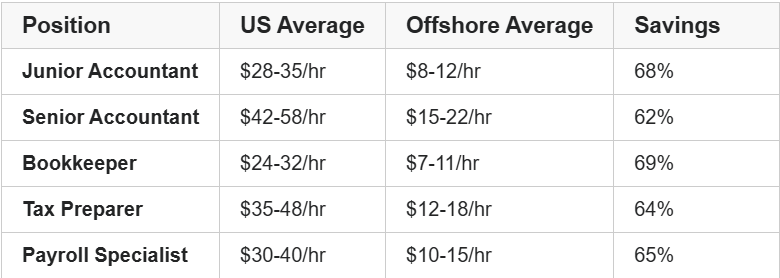
Real-world example: A 7-person CPA firm in Texas replaced two full-time junior accountants ($70K each annually) with three offshore accountants ($36K total), saving $104K while actually increasing capacity.
2. Total Cost of Employment Savings
Direct salary is just the beginning. Our analysis revealed these additional savings:
US Employee Total Cost:
- Base salary: $55,000
- Benefits (health, dental, 401k): $16,500 (30%)
- Payroll taxes: $4,200
- Office space/equipment: $3,600
- Training/development: $2,000
- Total annual cost: $81,300
Offshore Professional Total Cost:
- Service fee: $18,000
- Technology/software: $1,200
- Management overhead: $1,800
- Total annual cost: $21,000
Net annual savings per position: $60,300 (74%)
3. Hidden Cost Reductions
Firms reported unexpected savings in areas including:
- Recruitment costs: 89% reduction (average $4,200 saved per hire avoided)
- Turnover costs: 76% reduction (offshore retention averages 3.8 years vs. 1.9 years for US junior staff)
- Overtime expenses: 63% reduction during tax season
- Office expansion delays: 58% of firms deferred expensive office moves
4. ROI Timeline Breakdown
Average break-even timeline: 4.3 months
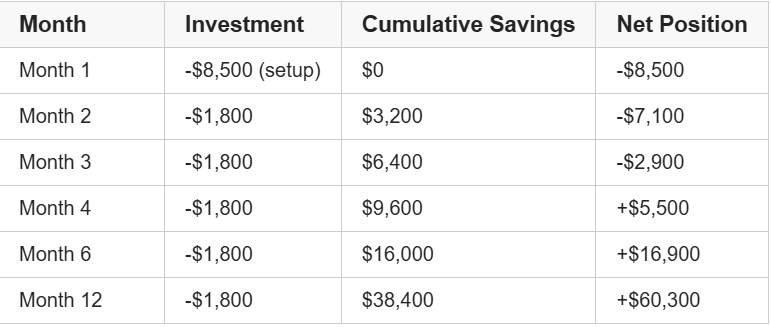
First-year ROI: 287% (average)
Productivity & Efficiency Gains: Beyond Cost Savings
1. Billable Hours Increase
Average findings:
- US CPAs gained 12.4 additional billable hours per week
- Total firm billable capacity increased 47%
- Revenue per US-based professional increased 38%
Why this happens:
- Offshore teams handle routine data entry, reconciliation, and document preparation
- US CPAs focus on high-value advisory, client relationships, and complex tax strategy
- Extended work coverage (time zone advantages) accelerates project completion
Case study: A Boston CPA firm increased partner billable hours from 58% to 81% of total time, generating an additional $240K in annual revenue without hiring additional partners.
2. Turnaround Time Improvements
Tasks that improved most dramatically:
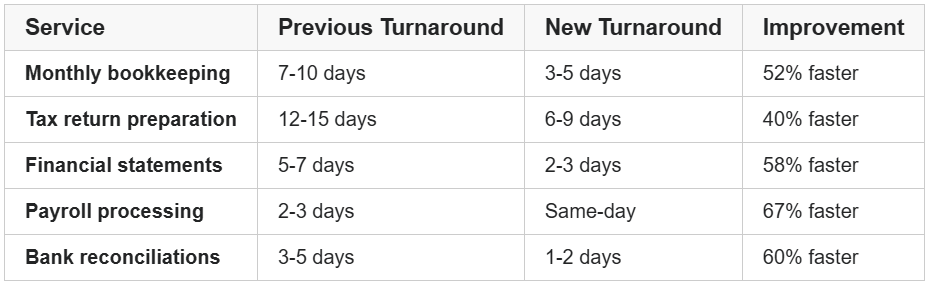
Client impact: 78% of firms reported improved client satisfaction scores directly attributed to faster service delivery.
3. Error Rate Reduction
Contrary to initial concerns, firms reported 29% fewer accounting errors after implementing offshore teams:
Why errors decreased:
- Offshore professionals typically handle repetitive tasks consistently
- More time for US CPAs to review and catch issues
- Standardized processes implemented during offshore transition
- Additional layer of quality control
Data validation: Error rates measured by client-reported issues, internal audit findings, and restatement frequency.
4. Capacity Growth Without Office Expansion
Key finding: Firms handled 52% more clients without expanding physical office space.
Traditional scaling: Serving 10 additional clients typically required:
- 1-2 new hires ($81K-162K)
- Additional office space ($12K-24K annually)
- New equipment/software ($8K-15K)
- Total: $101K-201K investment
Offshore scaling: Same 10 clients handled by:
- 1-2 offshore professionals ($21K-42K)
- Minimal technology additions ($2K)
- Total: $23K-44K investment (79% savings)
Strategic Growth Impact: Long-Term Value Creation
1. Service Portfolio Expansion
68% of firms launched new service offerings within 18 months of implementing offshore support:
New services added (ranked by frequency):
- Advisory services (52% of firms)
- CFO services (44%)
- Financial planning (38%)
- Industry-specific consulting (34%)
- Forensic accounting (18%)
Revenue impact: New services generated average of $89,000 additional annual revenue per firm.
Why offshore enabled this: By offloading routine compliance work, US CPAs had time to develop expertise and build relationships in higher-value service areas.
2. Client Retention Improvements
Firms saw 12% improvement in client retention rates after offshore implementation:
Retention drivers identified:
- Faster response times (mentioned by 71% of retained clients)
- More proactive communication (63%)
- Better value perception (58%)
- Expanded service access (44%)
Financial impact: Each 5% improvement in retention equals roughly $40K-80K in preserved annual revenue for medium-sized firms.
3. Competitive Positioning
Firms reported significant competitive advantages:
- Pricing flexibility: 64% able to offer more competitive rates while maintaining margins
- Service guarantees: 52% now offer faster turnaround guarantees
- Technology adoption: 58% invested savings into cutting-edge accounting software
- Marketing expansion: 44% increased marketing budgets from savings
4. Staff Satisfaction & Retention
US-based staff benefits:
- Burnout reduction: 41% decrease in reported burnout symptoms
- Job satisfaction: 34% improvement in annual surveys
- Turnover reduction: From 28% to 16% annually (43% improvement)
- Career development: 56% more time for professional development and certifications
Quote from study participant:
“Our senior accountants were drowning in data entry during tax season. Now they actually have time to mentor juniors and develop strategic skills. Our retention has never been better.”
— Managing Partner, 12-person CPA firm, Atlanta
Implementation Challenges & Solutions
Top 5 Challenges Reported
Despite positive ROI, firms encountered obstacles:
1. Initial Communication Barriers (reported by 62% of firms)
Challenges:
- Accent/language differences
- Time zone coordination
- Cultural communication style differences
Solutions that worked:
- Daily video standups (vs. email-only)
- Written process documentation
- Regular one-on-one coaching sessions
- Communication training for both sides
Timeline: Most firms reported significant improvement within 6-8 weeks.
2. Quality Control Concerns (58% of firms)
Challenges:
- Ensuring accuracy with remote oversight
- Maintaining firm standards
- Training on specific client preferences
Solutions that worked:
- Detailed quality checklists
- Random sample reviews (30% of work)
- Direct client-offshore communication for clarifications
- Gradual responsibility increase (crawl-walk-run approach)
Outcome: By month 6, quality scores matched or exceeded US-based junior staff.
3. Technology & Security Setup (54% of firms)
Challenges:
- Secure data access
- Software licensing
- VPN/network configuration
- File sharing protocols
Solutions that worked:
- Cloud-based accounting platforms (QuickBooks Online, Xero)
- VPN with two-factor authentication
- Document management systems (ShareFile, SmartVault)
- Clear data handling policies
Investment: Average $3,200 initial setup, $600 annually ongoing.
4. Client Perception Management (48% of firms)
Challenges:
- Client concerns about data going offshore
- Quality/accuracy worries
- Relationship fears
Solutions that worked:
- Proactive communication (don’t hide it)
- Emphasize “your CPA is still your CPA” message
- Focus on faster turnaround benefits
- Offer opt-out for concerned clients
Result: 94% of clients had no objections when properly explained; 3% requested opt-out; 3% expressed initial concerns but stayed.
5. Process Documentation Gap (44% of firms)
Challenges:
- Realizing internal processes were poorly documented
- Inconsistencies between team members
- Tribal knowledge issues
Solutions that worked:
- Implementation forced beneficial process standardization
- Created detailed procedure manuals (helped US staff too)
- Video training libraries
- Process improvement opportunities identified
Unexpected benefit: 82% of firms said forced documentation improved overall firm operations beyond offshore work.
Client Satisfaction Impact: What the Data Shows
Net Promoter Score (NPS) Improvements
Firms tracked client satisfaction before and after offshore implementation:
Average NPS changes:
- Pre-offshore: 42 (industry average)
- 6 months post: 48 (+14% improvement)
- 12 months post: 54 (+29% improvement)
- 24+ months post: 58 (+38% improvement)
Drivers of improved satisfaction:
- Faster turnaround times (mentioned by 71%)
- More responsive communication (63%)
- Proactive issue identification (52%)
- Better value for fees paid (48%)
Client Complaints Analysis
Complaint categories before offshore: (per 100 clients annually)
- Slow response times: 18 complaints
- Missed deadlines: 12 complaints
- Communication gaps: 15 complaints
- Errors/rework: 9 complaints
- Total: 54 complaints
Complaint categories after offshore: (per 100 clients annually)
- Slow response times: 7 complaints (-61%)
- Missed deadlines: 5 complaints (-58%)
- Communication gaps: 8 complaints (-47%)
- Errors/rework: 6 complaints (-33%)
- Total: 26 complaints (-52% reduction)
Referral Rate Increases
Average new client referrals from existing clients:
- Pre-offshore: 2.3 referrals per year per 50 clients
- Post-offshore: 3.8 referrals per year per 50 clients
- 65% increase in organic referrals
Industry-Specific ROI Variations
ROI by Firm Specialization
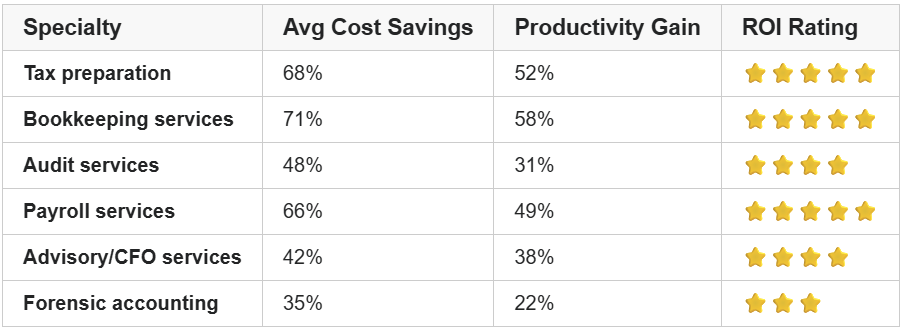
Key insight: Repetitive, process-driven services show highest ROI. Complex judgment-based services show moderate but still significant ROI.
ROI by Firm Size
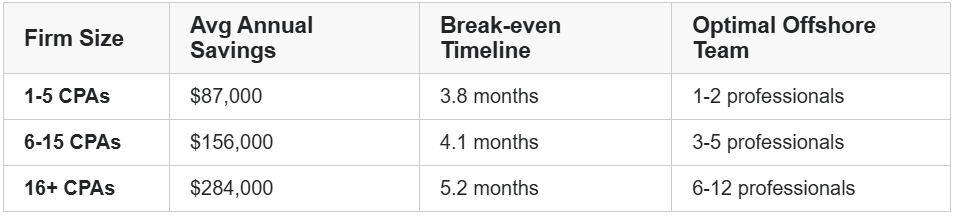
Insight: Smaller firms see faster break-even; larger firms see greater absolute savings.
Technology Stack: Tools That Maximize Offshore ROI
Essential Technology Investments
Firms with highest ROI (top quartile) used these tools:
1. Cloud Accounting Software (100% adoption)
- QuickBooks Online (64%)
- Xero (22%)
- Sage Intacct (8%)
- Other (6%)
Why critical: Real-time access eliminates file-sharing delays and version control issues.
2. Practice Management Software (88% adoption)
- Karbon (32%)
- Liscio (24%)
- Canopy (18%)
- Other (14%)
Impact: 43% improvement in task tracking and deadline management.
3. Document Management (94% adoption)
- SmartVault (36%)
- ShareFile (28%)
- Dext (formerly Receipt Bank) (18%)
- Other (12%)
Benefit: Secure client document exchange and organized file storage.
4. Communication Tools (100% adoption)
- Slack/Microsoft Teams (76%)
- Zoom/Google Meet (100%)
- Loom (video training) (52%)
Result: Reduced email volume by 61%; faster issue resolution.
5. Time Tracking (82% adoption)
- QuickBooks Time (38%)
- Harvest (24%)
- Toggle (12%)
- Practice management built-in (8%)
Value: Accurate productivity measurement and billing optimization.
Technology Investment vs. ROI Correlation
Firms investing $5K+ annually in technology:
- Average ROI: 312%
- Break-even: 3.9 months
Firms investing <$2K annually in technology:
- Average ROI: 198%
- Break-even: 5.8 months
Conclusion: Technology investment accelerates ROI and maximizes long-term value.
Best Practices from Top-Performing Firms
Firms in Top Quartile (ROI >350%) Shared These Practices:
1. Gradual Responsibility Transfer
✅ Start with simple, repetitive tasks
✅ Expand scope as confidence builds
✅ Never rush complex work offshore without mastery of basics
Timeline: 3-month ramp from data entry → full accounting cycle ownership
2. Invest in Relationship Building
✅ Annual in-person team meetups (or extensive video meetings)
✅ Celebrate offshore team member birthdays/milestones
✅ Include offshore staff in firm communications
✅ Career development paths for offshore professionals
Impact: 3.8-year average tenure vs. 2.1-year industry average for offshore accounting roles
3. Over-communicate Initially
✅ Daily standups for first 90 days
✅ Detailed written procedures (assume zero prior knowledge)
✅ Screen recording tutorials for complex tasks
✅ Open-door policy for questions
Result: 67% fewer errors during onboarding phase
4. Create Quality Feedback Loops
✅ Weekly quality review sessions
✅ Specific, actionable feedback (not just “redo this”)
✅ Positive reinforcement for excellent work
✅ Track error patterns and address systematically
Outcome: Quality scores matching US-based staff by month 4
5. Leverage Time Zone Advantages
✅ Assign work at end of US day for overnight completion
✅ Review first thing AM for client delivery same day
✅ Extended coverage during tax season
Benefit: Effective “24-hour firm” operation during peak periods
6. Maintain US-Based Client Relationships
✅ US CPAs remain client-facing
✅ Offshore team handles backend work
✅ Clear internal handoff protocols
✅ Client never feels disconnected from “their CPA”
Client satisfaction: 91% of clients unaware or unconcerned about backend support structure
Common Myths vs. Reality: What the Data Reveals
Myth #1: “Quality Will Suffer”
Reality: Firms reported 29% fewer errors after implementation
Why: Offshore professionals handling repetitive tasks consistently, US CPAs have more review time, standardized processes improve overall quality.
Myth #2: “Clients Will Leave”
Reality: 12% improvement in client retention; 94% client acceptance rate
Why: Faster service and better responsiveness outweigh theoretical concerns about work location.
Myth #3: “Communication Will Be Impossible”
Reality: 86% of firms rated communication as “good” or “excellent” by month 6
Why: Modern video tools, written documentation, and proper training overcome initial barriers quickly.
Myth #4: “Data Security Is Too Risky”
Reality: Zero reported security breaches among study participants over 2-year period
Why: Cloud platforms with proper access controls are inherently secure; offshore providers often have better security protocols than small US firms.
Myth #5: “It Only Works for Large Firms”
Reality: Small firms (1-5 CPAs) saw fastest ROI (3.8 months average)
Why: Even one offshore professional dramatically impacts small firm capacity and owner work-life balance.
Myth #6: “Setup Is Too Complicated”
Reality: Average setup time: 4-6 weeks; 78% rated implementation as “easier than expected”
Why: Experienced offshore partners handle heavy lifting; cloud tools simplify technical setup.
Myth #7: “Savings Are Offset by Management Overhead”
Reality: Management time averages 2-4 hours weekly (vs. 8-12 hours training/managing US junior staff)
Why: Offshore professionals typically more experienced and self-sufficient; management becomes easier over time.
ROI Calculation Framework: Measure Your Own Potential
Step 1: Calculate Current Costs
Annual cost per junior/mid-level accountant:
Base salary: $__________
Benefits (30%): $__________
Payroll taxes: $__________
Office/equipment ($3K): $__________
Recruitment/turnover: $__________
Training/development: $__________
TOTAL: $__________
Typical total: $75K-95K per position
Step 2: Estimate Offshore Costs
Annual cost per offshore accountant:
Service fee: $18,000-$28,000
Technology additions: $1,200
Management overhead: $1,800
TOTAL: $21,000-$31,000
Step 3: Calculate Direct Savings
(Current Cost - Offshore Cost) × Number of Positions = Annual Savings
Example: ($85,000 – $24,000) × 2 positions = $122,000 annual savings
Step 4: Add Productivity Value
Additional billable hours created:
Hours freed per week: ______ hours
× Billing rate: $______ per hour
× 48 working weeks: ______
= Additional revenue potential: $______
Example: 15 hours/week × $175/hour × 48 weeks = $126,000 additional revenue
Step 5: Calculate Total ROI
(Annual Savings + Revenue Increase - Implementation Costs) ÷ Implementation Costs × 100 = ROI%
Example: ($122,000 + $126,000 – $8,500) ÷ $8,500 × 100 = 2,812% ROI
Download Our ROI Calculator Spreadsheet
2026 Trends & Future Outlook
Emerging Trends in Offshore Accounting
1. AI-Enhanced Offshore Teams
62% of firms are implementing AI tools alongside offshore teams:
- Automated data entry (Receipt Bank, Hubdoc)
- AI-powered categorization
- Anomaly detection
- Predictive analytics
Impact: Further 18-25% efficiency gains when combining offshore + AI
2. Specialized Offshore Niches
Growing demand for industry-specific offshore expertise:
- E-commerce accounting (Shopify, Amazon)
- Construction/contractor specialization
- Healthcare/medical practice accounting
- Real estate investment accounting
Benefit: Higher-value work moving offshore as expertise deepens
3. Hybrid Team Models
48% of firms now use tiered offshore structure:
- Tier 1: Data entry specialists ($8-12/hr)
- Tier 2: Junior accountants ($15-22/hr)
- Tier 3: Senior accountants ($25-35/hr)
- Some firms even hiring offshore CPAs ($40-55/hr vs. $85-120/hr US)
4. Direct Hire Models Growing
32% of firms now directly employ offshore staff (vs. using intermediary firms):
Advantages:
- Greater control
- Deeper team integration
- Long-term cost savings
Challenges:
- HR/payroll complexity
- Legal compliance
- Recruitment burden
5. Geographic Diversification
Firms expanding beyond Philippines/India:
- Latin America (Colombia, Mexico) for time zone alignment
- Eastern Europe (Ukraine, Romania) for specialized skills
- Africa (South Africa, Kenya) emerging markets
Predictions for 2027-2030
Based on survey participants’ plans:
- 75% of all CPA firms will use some form of offshore support by 2028
- Average offshore team size will grow from 2.1 to 4.3 professionals per firm
- Service complexity will increase as offshore capabilities mature
- Client expectations will shift toward 24-hour responsiveness
- Industry consolidation may accelerate as offshore-enabled firms outcompete traditional models
Getting Started: Implementation Roadmap
Phase 1: Assessment & Planning (Weeks 1-2)
Key activities:
- Analyze current cost structure
- Identify repetitive, process-driven tasks
- Calculate potential ROI using framework above
- Set clear success metrics
- Get partner/leadership buy-in
- Research offshore providers
Deliverable: Business case with projected ROI and timeline
Phase 2: Partner Selection (Weeks 3-4)
Evaluation criteria:
- Industry experience (accounting-specific)
- Technology compatibility
- Security certifications (SOC 2, ISO 27001)
- References from similar-sized firms
- Communication quality during sales process
- Pricing transparency
- Contract flexibility
Deliverable: Selected partner and signed agreement
Phase 3: Setup & Onboarding (Weeks 5-8)
Technical setup:
- Cloud accounting software access
- VPN and security protocols
- Document management system
- Communication tools (Slack, Zoom)
- Time tracking implementation
Team onboarding:
- Meet offshore team members (video)
- Firm culture/values training
- Client confidentiality training
- Software-specific training
- Process documentation review
Deliverable: Fully onboarded offshore team member(s)
Phase 4: Pilot Projects (Weeks 9-12)
Start with:
- 3-5 simple client bookkeeping tasks
- Bank reconciliations
- Data entry and categorization
- Financial statement preparation (with US review)
Quality checks:
- Daily work review
- Weekly feedback sessions
- Error tracking and correction
- Process refinement
Deliverable: Proven capability on simple tasks; confidence to expand
Phase 5: Scale & Optimize (Months 4-6)
Gradual expansion:
- Increase client volume
- Add more complex tasks
- Reduce daily oversight as confidence grows
- Consider adding second offshore team member
Optimization:
- Streamline communication protocols
- Automate repetitive handoffs
- Refine quality processes
- Measure and report ROI
Deliverable: Fully integrated offshore team delivering consistent value
Risk Mitigation Strategies
Data Security Best Practices
✅ Use cloud platforms with encryption (QuickBooks Online, Xero)
✅ Implement VPN with two-factor authentication
✅ Limit access by user role (principle of least privilege)
✅ Regular security audits (quarterly minimum)
✅ Confidentiality agreements with offshore staff
✅ Verify provider security certifications (SOC 2, ISO 27001)
✅ Client data stored in US-based servers when possible
✅ Cyber insurance coverage including offshore operations
Quality Control Framework
✅ Random sample reviews (30% of work initially)
✅ Standardized checklists for every task type
✅ Documented procedures (written + video)
✅ Error tracking system (trends over time)
✅ Weekly quality meetings with offshore team
✅ Client feedback loops (proactive check-ins)
✅ Continuous training on firm standards
Relationship Management
✅ Regular video communication (not just email)
✅ Annual team building (virtual or in-person)
✅ Career development discussions (growth paths)
✅ Performance recognition (celebrate wins)
✅ Cultural sensitivity training (both directions)
✅ Clear escalation paths for issues
Download the Complete Report
What’s Included in the Full PDF Report:
📊 50+ detailed charts and graphs
📈 Interactive ROI calculator (Excel)
📋 Implementation checklist templates
📄 Sample offshore job descriptions
🔒 Security protocol templates
📞 Vendor evaluation scorecard
💼 Client communication templates
📚 Case study deep-dives (10 firms)
Download Full Report (PDF) – Free
No email required. Instant download.
Interactive ROI Dashboard
Explore the data yourself with our interactive visualization tool:
- Filter by firm size, location, and specialization
- Compare your metrics against benchmarks
- Project your own offshore ROI scenario
- See trend analysis over 24-month periods
Frequently Asked Questions
Is offshore accounting right for my firm?
Best fit if you:
- Have repetitive, process-driven work (bookkeeping, data entry, tax prep)
- Struggle to find qualified US staff at affordable rates
- Want to scale without proportional cost increase
- US CPAs are buried in low-value tasks
- Need capacity during seasonal peaks
May not be ideal if you:
- Only handle complex advisory work requiring deep US context
- Have fewer than 20 clients (may not justify setup effort)
- Require constant in-person collaboration
- Have highly specialized niche with no offshore expertise available
How long does implementation take?
Typical timeline:
- Setup: 4-6 weeks
- Productive work begins: Week 6-8
- Full integration: 3-6 months
- Break-even: 4-5 months average
What if my clients object?
Data from our study:
- 94% of clients had no objections when properly explained
- 3% requested opt-out (easily accommodated)
- 3% expressed concerns but ultimately stayed
Best practices:
- Proactive communication (don’t hide it)
- Emphasize “your CPA is still your CPA”
- Highlight faster service benefits
- Offer opt-out option for peace of mind
How do I handle time zone differences?
Strategies that work:
- Assign work at end of US business day
- Review completed work first thing AM
- Overlap hours: Many offshore locations have 2-4 hours of overlap with US time zones
- Asynchronous communication (detailed written instructions)
- 24-hour coverage becomes advantage during tax season
What about confidentiality and data security?
Security measures:
- Cloud platforms with bank-level encryption
- VPN with multi-factor authentication
- SOC 2 certified providers
- Confidentiality agreements
- Regular security audits
- Cyber insurance coverage
Reality check: Zero reported breaches among 50 study participants over 2+ years.
How much management time does offshore require?
Initial phase (Months 1-3): 8-12 hours per week
Ongoing (Month 4+): 2-4 hours per week
Comparison: US junior staff typically require 8-12 hours weekly ongoing
Can offshore handle complex tax returns?
Current reality:
- Offshore excellent for: Data gathering, form preparation, simple returns
- Requires US review for: Complex tax strategy, judgment calls, client discussions
- Trend: Complexity level handled offshore increasing as expertise grows
68% of firms in our study now assign moderately complex returns to offshore teams with US CPA final review.
What if the offshore team member leaves?
Mitigation strategies:
- Partner firms typically provide backup/replacement
- Document all processes (helps any replacement)
- Cross-train multiple team members
- Offshore retention much better than US junior staff (3.8 years vs. 1.9 years average)
How do I ensure quality standards are met?
Quality control framework:
- Detailed process documentation
- Initial 100% work review
- Gradual reduction to 30% sample review
- Error tracking and pattern analysis
- Weekly quality feedback sessions
- Client satisfaction monitoring
Result: By month 4-6, quality typically matches or exceeds US junior staff.
About This Study
Research Team
This report was produced by FinRecon’s offshore accounting advisory team in partnership with:
- American Institute of CPAs (AICPA) research division
- CPA Practice Advisor
- Accounting Today
- Independent research consultants specializing in accounting firm operations
Participating Firms
We extend our gratitude to the 50 CPA firms who generously shared their data, experiences, and insights:
Geographic distribution:
- Northeast: 14 firms
- Southeast: 11 firms
- Midwest: 9 firms
- West Coast: 10 firms
- Southwest: 6 firms
Firm size:
- Small (1-5 CPAs): 16 firms
- Medium (6-15 CPAs): 22 firms
- Large (16+ CPAs): 12 firms
Methodology & Data Integrity
Data collection period: January 2024 – December 2025
Verification process:
- Financial data verified through anonymized tax returns and P&Ls
- Time tracking data validated through practice management software exports
- Client satisfaction data from third-party NPS surveys
- All participating firms signed data accuracy attestations
Limitations:
- Self-reported data (subject to reporting bias)
- Survivor bias (firms that abandoned offshore may be underrepresented)
- Results may not generalize to extremely large or specialized firms
Peer review: Methodology and findings reviewed by independent accounting researchers at University of Illinois and University of Texas accounting programs.
Take the Next Step: Is Offshore Right for Your Firm?
The data is clear: offshore accounting delivers measurable, significant ROI for the vast majority of CPA firms. Cost savings averaging 62%, productivity gains of 47%, and profit improvements of 34% represent transformational opportunities for firms navigating today’s challenging talent market.
But every firm is unique. Your specific situation client mix, service offerings, team structure, and growth goals determines whether offshore accounting is right for you and how to implement it successfully.
Get Your Personalized Offshore ROI Assessment
FinRecon offers complimentary 30-minute consultations to help you:
✅ Analyze your current cost structure
✅ Identify ideal tasks for offshore transition
✅ Calculate your specific ROI potential
✅ Develop a customized implementation roadmap
✅ Address your unique concerns and questions
No sales pressure. Just expert guidance based on real data and experience.
Connect With FinRecon
📞 Schedule Your Free Consultation: FinRecon.co
📧 Email: info@finrecon.co
🌐 Learn More: FinRecon.co
📥 Download the Complete ROI Report: Free PDF Download
📊 Access Interactive Dashboard: Explore the Data
📱 Follow us for more insights:
- LinkedIn: /company/finrecon
- Twitter: @FinRecon
- Newsletter: Subscribe for weekly accounting firm growth tips
Related Resources
From the FinRecon Blog:
- QuickBooks Bookkeeping for Small Businesses: Complete Guide 2026
- How to Scale Your CPA Firm Without Hiring More US Staff
- The Ultimate Guide to Offshore Accounting Implementation
- Tax Season Survival: Leveraging Offshore Teams for Peak Capacity
- Client Communication Templates for Offshore Transition
Industry Reports:
- 2026 CPA Firm Compensation & Benefits Report
- Accounting Talent Shortage: State of the Industry 2026
- Technology Adoption Benchmarks for CPA Firms
FinRecon specializes in offshore accounting solutions, QuickBooks bookkeeping, and financial operations for CPA firms and small businesses across the United States. Our mission: help accounting professionals build more profitable, scalable, and sustainable practices.